
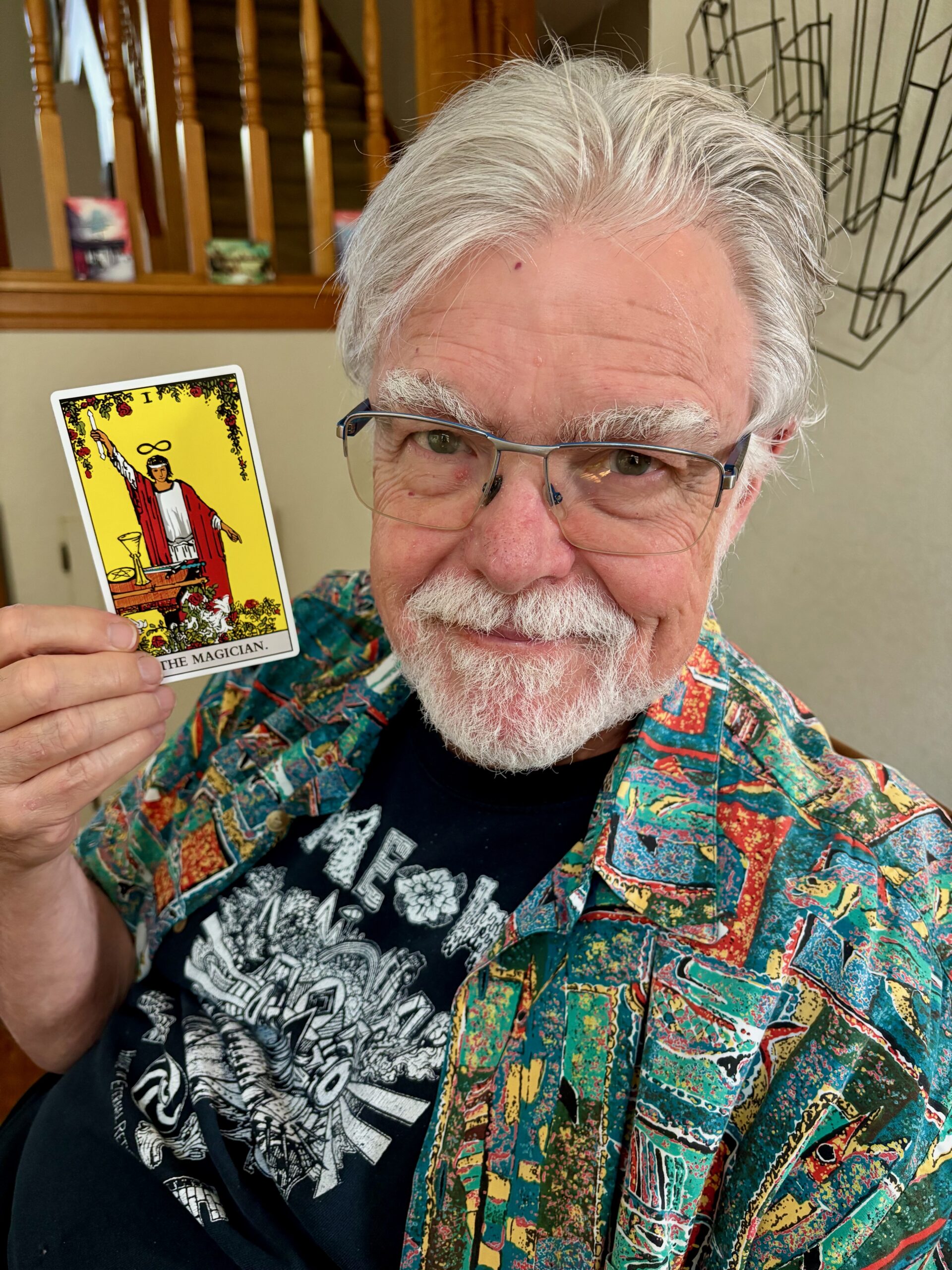
Thanks to Doomscroll for conducting and providing the interview!
Doomscroll
Welcome everyone! Today I'm joined by Jon Lebkowsky / @jonkl for a live conversation on digital culture and the evolving social web. You're invited to follow along, or participate directly, by using #DigitalCulture. Your questions and observations are part of the signal.
Just a quick heads-up: our conversation with Jon is happening asynchronously. That means it won't move at a steady pace the whole time. Questions and replies may come in waves, depending on what's happening in our everyday lives: phone calls, meetings, coffee refills, or the occasional bathroom break. Think of it as a relaxed, come-and-go conversation rather than a live broadcast.
Today's agenda: we'll explore digital culture, online communities, and how federated and decentralized platforms are reshaping social life. We'll talk about power, governance, creative resistance, and what the next phase of the internet might look like. Join the conversation via #DigitalCulture.
Jon Lebkowsky is a writer, strategist, and longtime observer of digital culture. Active since the early days of the web, he has worked across cyberculture, online communities, and media innovation, tracking how networks shape identity, politics, and creativity. His background includes FringeWare Review, the EFF, Mondo 2000, Whole Foods Market, The WELL, Plutopia, and much more. Few have watched the social web evolve this closely.
Learn more about Jon here: https://en.wikipedia.org/wiki/Jon_Lebkowsky
Thanks for joining us, Jon. Today's conversation is an experiment. We're hosting it live here on Mastodon and inviting people on the timeline to join in as the discussion unfolds.
You've been around the internet long enough to see it change a few times over. Before we dive into any specific platforms or debates, I'd love to start simple. What do you think people most often get wrong about what it really takes to keep an online space healthy over time?
Jon Lebkowsky
Good question, Doomscroll. There's no technical solution for keeping online spaces healthy. It takes a human solution. You have to socialize it. We hear about having moderators online, but I prefer the concept of the host, as we've had for four decades on the WELL, one of the earliest online communities and still active today. Originally the host on the WELL was called “fairwitness,” just to give you an idea how the role works. Hosts keep humans in conversation sorted.
The difficulty in hosting or moderation is that it doesn't scale. If you have millions of users, you can't host all at once. Online community doesn't scale; as communities grow, they tend to either become less like community, or the users break out into manageable groups.
Doomscroll
I like the concept of a host. Jon, when an online space works well for years instead of burning out quickly, what's usually doing the work behind the scenes that people don't notice much?
Jon Lebkowsky
The WELL is, again, a good example of what works for online community. Part of why it works is structural: a linear asynchronous conferencing format that feels like real conversation. Also, in addition to hosts, there's a central management team that supports the hosts. And the hosts have a private space where they can share ideas and concerns. All very helpful, and all of this is different from the typical drive-by social media platform.
Doomscroll
I had no idea how much was going on behind the scenes, Jon. When things start to go sideways online, where do you usually see that sense of responsibility slipping first: on the platform side, with the people using the space, or with the institutions that used to help hold things together?
Jon Lebkowsky
Online platforms for social interaction are not inherently great for bringing people together because structurally they favor bursts of activity versus longer, deeper conversations. And some, like Facebook and X, are focused on profits, so the users are not supported but manipulated to support engagement, especially with advertisers. It's hard to have a sense of community when you don't even know for sure who's seeing your posts.
And of course, they tend to put little value on accountability when, as you say, things go sideways. I do think that systems that aren't focused on profit and not algorithmically manipulative, like Mastodon and so far Bluesky, provide better support for conversation. But structurally, a microblog platform is not ideal for community-building.
Doomscroll
We talk a lot about platforms failing communities, but where have you seen open systems struggle because the participants themselves stopped taking responsibility?
That makes a lot of sense. Jon, if platforms are built around bursts and visibility instead of continuity, what have you seen actually help people rebuild a sense of community anyway? Are there small design choices or social habits that seem to make longer, deeper conversations possible, even inside systems that weren't really designed for them?
Jon Lebkowsky
There are platforms that aren't ad-based and that are created for groups rather than mass communication. Closer to the forum structure than the drive-by posting structure. Discord is one, and Slack. Most recently I've seen communities supported by Signal. The app supports group forming. I think it's possible to tie groups together on microblog platforms with hashtags or lists, but it's harder.
Doomscroll
I was going to ask you about that, Jon. I'm on all those platforms. I use all of those platforms. But I keep circling back to spaces with pluralistic values, platforms that don't lock you in. That's the appeal of Mastodon. You could just as easily spin up Discord servers or Signal threads. There's more friction, yes, but friction buys privacy. And privacy changes how people behave.
Doomscroll
Another question, Jon. Early internet culture talked a lot about freedom. Looking back, what kinds of responsibility do you think we didn't think through as carefully?
Jon Lebkowsky
Libertarians talked a lot about freedom, but they didn't have a good understanding of the concept. Freedom is inherently never absolute. It's shared, and that sharing brings constraints. Those who oppose government or regulation don't get how government can mediate individual freedoms so that one person's freedom isn't destructive to another's. More generally, I don't think we understood that society works best when we all share responsibility and embrace accountability.
Doomscroll
Where do you think pulling back support or structure online has been sold as “empowering users,” when it was really more like leaving people on their own?
Jon Lebkowsky
I don't think it was a hard sell. People believed they were empowered, I think. Some probably still think so.
Doomscroll
Are there kinds of conversations you've seen disappear once attention, likes, or metrics became the main way people got feedback?
Jon Lebkowsky
I would say not so much kinds of conversation as depth of conversation, and maybe coherence. On systems like the WELL or Usenet, I think we were more conversational. Structure is part of it, and scale is a big part of it. Right now people are hyper-obsessed with political conversation, and there's more misinformation and disinformation.
Doomscroll
The WELL is one of the internet's oldest online communities, started back in the 1980s. It's a place where people have long, thoughtful conversations without algorithms pushing things around. The State of the World is an annual discussion led by you and Bruce Sterling, where members reflect on what's happening in society, politics, and culture over time, sharing perspectives without the rush or noise of modern social media.
If someone read this year's State of the World conversations on The WELL as a long-running signal instead of a discussion thread, what would they learn that wouldn't show up in the news?
Jon Lebkowsky
Bruce especially has traveled widely and has a breadth of global experience, and a science fiction and futurist perspective, producing insights that a normal news organization would be unlikely to convey. I also have my own unusual path. I studied journalism but worked in poverty programs, in business, and since 1990 have been deeply embedded in digital culture.
Doomscroll
Compared to earlier years, do you notice people framing crisis and decline in mostly the same ways, or does it feel like something has shifted?
Jon Lebkowsky
Clearly something has shifted. We are in a state of emergency. The United States is experiencing a dangerous shift toward authoritarian rule, and the proposed ruler is at least incompetent and more likely experiencing one or more forms of mental illness. We are overusing and corrupting national resources, and our carbon emissions are overheating the planet, with the danger that it will become uninhabitable. Much wealth has shifted to the top one percent. Awareness of all this changes the frame.
Doomscroll
This is important. I have a lot of questions on this topic. I will try to keep it to four.
When a country starts to feel like it is always in crisis mode, what kinds of behavior begin to seem normal that probably would not have before? Where do you see people quietly getting used to things they once would have pushed back on?
Jon Lebkowsky
Probably most obvious is that we now take for granted that supposed leaders in the current administration are dishonest, that they lie and create narratives that barely conform to reality. They are speaking fantasy to fantasy, appealing to and reinforcing incorrect beliefs held by their followers. Alternate facts, as Conway said during Trump 1.0. This creates confusion and chaos as they flood the zone. But we are actually getting used to it.
Doomscroll
When people are very aware that big systems are failing, how does that change what they are willing to accept from leaders or institutions? Does exhaustion make people more compliant, or more stubborn?
Jon Lebkowsky
Honestly, I do not think we can generalize about people. Some will become more compliant, some more stubborn. As we see in Minnesota, there are people who, when pushed far enough, will resist immoral, corrupt, or criminal practices. Some of those people are exhausted, but realizing what is at stake, they persist. There are almost certainly others who are compliant.
Doomscroll
When we frame everything as an emergency, which problems get the most attention, and which ones quietly fade into the background? What do you think we are not seeing clearly right now?
Jon Lebkowsky
I am not thinking we frame everything as an emergency, and not everybody would agree that we are at the level of emergency. But to your question, I think our priority right now is stopping a global slide toward protofascism and authoritarianism, and after that restoring an embrace of and respect for science and fact. This may seem to suggest that concern for climate is fading into the background, but climate denial is a symptom of the slide to the right.
Doomscroll
If this sense of emergency is not just a phase, what kinds of systems do you think people are now willing to live with that would have seemed unacceptable ten years ago?
Jon Lebkowsky
I think we are living now with a system of government that would have seemed unacceptable ten years ago. My hope would be to restore a more democratic system and diminish corruption in government and business. I like the idea of cooperative enterprise. We have had cooperatives, but their influence has been limited. Where climate is concerned, I think we have to reduce resource consumption and carbon emissions, and so far as a society we have been unwilling to do that.
Doomscroll
Plutopia is an ongoing project and podcast that brings together curious, thoughtful people to make sense of the world. It looks at where technology, politics, culture, and the future collide, questioning easy stories and exploring better possibilities. The name blends pluralism and utopia, pointing to a hopeful idea of a world where different people and ideas can coexist with respect.
Plutopia feels more like an invitation than a finished blueprint. What does leaving things open like that let you explore that you could not if you were trying to argue for one clear solution?
Jon Lebkowsky
One downside is that lacking a specific theme or focus can make it hard to build an audience. But it allows us to explore guided primarily by what we find interesting, acknowledging that our interests can be broad and can change. We look for interesting people and try to have fun with the conversations. Our guests often tell us that they had a good time. We could do artificial intelligence one week, climate change the next, politics the next, and we learn a lot as we go.
Doomscroll
Let us continue that thread. Plutopia sits right where technology, politics, and culture all bump into each other. How do you decide which conversations are worth taking your time with, especially when so much media today pushes people to be fast and certain?
Jon Lebkowsky
We follow our noses, but we have pretty good instinct. Wendy Grossman, our UK-based co-host, has a lot of connections in the tech, civil liberties, and skeptic worlds. I know a lot of people from my years online with backgrounds both technical and cultural. Scoop and I have both been counterculture mavens for decades. It also helps that we are self-funded and completely independent. We all have pretty good radar for spotting great potential guests.
Doomscroll
What does your guest selection say about the future you think is actually coming, not the one people claim to want?
Jon Lebkowsky
I personally do not have a set vision for the future. I am a Buddhist and stay pretty much in the present, not trying to guess or grasp what is to come. Our guest selection is pretty diverse. We have talked to science fiction authors, skeptics, climate scientists, computer scientists, political thinkers, philosophers, cyber libertarians, and others. We have gotten away from pluralist utopias, the source of our name. We are all over the place.
Doomscroll
You mentioned having a radar for potential guests. What disqualifies someone immediately, even if they are prominent or timely?
Jon Lebkowsky
I can only think of one reason we would disqualify someone who's captured our interest, an assumption that they would demand an audience larger than we can provide. We want people we can contact directly, without going through agents or publicists, and who aren't especially concerned about reach. There are plenty of cool and interesting people who are up for good conversation for smaller but smart audiences.
Doomscroll
You often poke at familiar stories on Plutopia without rushing to replace them with a new one. What do you think that kind of open-ended questioning offers right now, when it feels like everyone's being pushed to pick a side and settle on answers quickly?
Jon Lebkowsky
@Doomscroll I have a history of leading with statements and assertions, but I've learned, and it's taken way too long to learn this, that it's always better to ask questions. I'm trying to cultivate an attitude of not-knowing, instead exploring and considering, drawing out different perspectives. One of my favorite sayings is "Everything you know is wrong."
Doomscroll
Are there online practices that survive precisely because no one has tried very hard to optimize them, and what do they manage to preserve?
Jon Lebkowsky
Good question. When you "optimize," you can lose things like user autonomy, authenticity, serendipity, and trust in favor of metrics, growth, and monetization. But some practices haven't changed much: individual, personal blogs and RSS syndication, mailing lists and some forums (like the WELL), IRC chat and similar. Apps that facilitate smaller groups.
Like Discord and Slack, tend to have minimal moderation, organic social norms, so you have better technology but similar practices. We still have instances of group-forming and community that work pretty much the same as always.
It was cool to see a whole movement form, the 50501 movement, from a Reddit post around a year ago to other community platforms where thousands of people showed up. I haven't mentioned Reddit before, but its forum technology is similar to the WELL's Engaged platform, and subreddits, like the WELL, are hosted or moderated by committed volunteers.
Doomscroll
Platforms like Discord and Slack pull a lot of conversation off the open web and into more closed spaces. How do you feel about that shift? Do you see it as a healthy way for communities to form, a loss for the wider public web, or a mix of both?
Jon Lebkowsky
I've mentioned before that community doesn't scale. It's hard to limit scale on the public web, the more closed spaces allow you to form groups in manageable chunks, where everybody can pretty much get to know everybody else. Scaling up to the public web inherently changes communication from interactive to broadcast.
Doomscroll
Are there online practices that survive precisely because no one has tried very hard to optimize them, and what do they manage to preserve? Looking back, are there parts of internet culture you wouldn't try to bring back, even if you could?
Jon Lebkowsky
I can think of downsides of early Internet culture, like streaks of misogyny and extreme libertarianism. But I think those still exist. I would certainly like to mitigate the capitalist capture of the Internet as a platform for profit-seeking, if I could go back and steer it differently. I don't know how possible that would have been. But that's not the same as "parts of internet culture."
Doomscroll
If those cultural pathologies were always there, and capital simply amplified what it could monetize, do you think "capture" was ever really avoidable? Or was the combination of under-governed infrastructure and scalable profit always going to resolve into ownership, no matter who was steering?
Jon Lebkowsky
Yeah, you have a point re. "under-governed." Part of the problem was that the technology ran well ahead of the policy – policymakers didn't understand well enough to create the right kind of regulatory infrastructure. And those who were focused on cyber liberties weren't savvy enough to envision the opportunities for exploitation and how they would be leveraged. I think I was too focused on the potential for social media to bring people together to see the dangers.
I'm reading Shira Chess's "The Unseen Internet" right now, and thinking about the evolution of memes, which she related to magical thinking and which has had an impact on politics. I'm wishing I'd had a better understanding of the power of memetics. Cory Doctorow says there is no internet mind control ray, but that might be wrong. Maybe we should have taken more seriously the persuasive power of certain images and phrases and systems like Q Anon.
I'm not clear those last two posts exactly answer your question, but that's the thinking you triggered. One thing I definitely wouldn't bring back is 300 baud modem access…!
Doomscroll
I'm unfamiliar with "The Unseen Internet," but I'm adding it to my reading list. If memetic systems work less by persuasion than by participation and repetition, where do you think the real leverage sits? At the level of images and phrases themselves, or in the platforms and incentives that reward people for inhabiting those shared story-worlds together?
Jon Lebkowsky
I wouldn't say "less by persuasion" – part of the persuasion or influence is in the participation and repetition, also contextual prompts and activators/signals. I had given it less thought in recent years until looking at Shira's work, though I was aware of it when I was part of FringeWare – we were deeply immersed in the occult and semiotic frameworks – but my attitude was ironic and skeptical, I might have missed the efficacy of the "magic" in those frameworks. DigitalCulture
Doomscroll
Taking everything we've talked about together (health, responsibility, continuity, etc) what feels most fragile online right now, and what feels more resilient than people might expect?
Jon Lebkowsky
The democratic intention that has been essential to the evolution of the USA over two and a half centuries is more fragile than we realized, obviously. The concept of an well-informed citizenry that's essential to democracy has been undermined by powerful traditional and social media sources spreading misinformation and disinformation intentionally and unintentionally, and the Internet has facilitated that in a big way.
The checks and balances that have been essential for democratic governance in the USA have also proved more fragile than we ever would have imagined. The source of resilience I see right now is in the people of Minnesota and elsewhere, beginning to stand against a corrupt authoritarian regime.
Incidentally I've just seen that a journalist has been indicted for the crime of journalism in the USA. That democratic intention I mentioned is taking a huge beating right now, as is the concept of truth. DigitalCulture
Doomscroll
If democratic institutions are fragile not because they were attacked outright but because truth, enforcement, and attention were gradually destabilized, where do you think resilience actually lives now? Is it still institutional (I'm guessing not), or has it moved to local networks, norms, and acts of refusal that exist largely outside formal systems? You mentioned what folks in Minnesota are doing. Anywhere else?
Jon Lebkowsky
I think there are pockets of activity nationwide, and they're growing. And some who supported the current administration initially are defecting. Resilience is in the people, and the Internet has a clear role in supporting those networks – not just of activists, but of citizens who are alarmed at what they're seeing. I had assumed that the American people, if they realized what they were actually losing, could resist, and that seems to be happening.
Jon Lebkowsky
Resilience is also with the courts, that seem to be standing up for Constitutional and democratic norms – except for the Supreme Court, unfortunately. But the courts are providing leadership right now.
Doomscroll
Thanks so much for taking the time to chat. I really appreciated the way you connected long-running spaces like the WELL, newer communities, and projects like Plutopia, and how you talked about care, responsibility, and staying human online. It felt less like an interview and more like thinking out loud together, which was exactly the point.

0 comments
I was interviewed here on Mastodon by @Doomscroll … here's the full interview assembled on a web page.
https://plutopia.io/jon-lebkowsky-interviewed-by-doomscroll/
Remote Reply
Original Comment URL
Your Profile
Why do I need to enter my profile?
This site is part of the ⁂ open social web, a network of interconnected social platforms (like Mastodon, Pixelfed, Friendica, and others). Unlike centralized social media, your account lives on a platform of your choice, and you can interact with people across different platforms.
By entering your profile, we can send you to your account where you can complete this action.